
Work done and elasticity

Physics · Forces. The idea in plain words, the rules to remember, the mistake to avoid and a worked example, written and checked by Mega Lecture.

Test this topic freeAll Physics topics

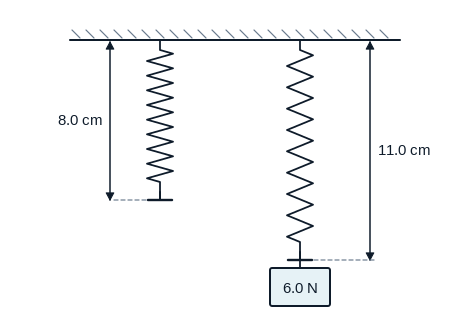
A spring hanging from a support is 8.0 cm long with no load; with a 6.0 N load hanging from it, its length is 11.0 cm.

The idea

Work is done when a force moves an object through a distance. Doing work transfers energy. Work done against friction raises the temperature of the object and its surroundings.

To stretch, bend or compress an object, more than one force must act. A single force would only make it accelerate. If the object returns to its original shape when the forces are removed, the deformation is elastic. If it stays changed, the deformation is inelastic.

For a spring, the extension is directly proportional to the force, up to the limit of proportionality. Beyond that point the force–extension graph is no longer a straight line.

In simpler words

Work is done when a force moves something a distance. Doing work moves energy. Stretching, bending or squashing needs more than one force. If something goes back to its shape, the change is elastic. For a spring, double the force gives double the stretch, up to a limit. After that, the graph bends.

An everyday comparison

A spring is like a rubber band that pulls back harder the more you stretch it. Each extra coin hung on it stretches it by the same amount, until you go past its limit. Then it stretches unevenly and may stay longer. The comparison stops being true because a rubber band does not follow the straight-line rule as closely as a spring does.

Rules to remember

Common mistake

Students use the total length of the spring instead of the extension, or leave the extension in centimetres. Subtract the original length first and convert to metres.

In the exam

For work done, write W = Fs, use the distance moved along the line of the force in metres, substitute and give the answer in J. For springs, find the extension first: stretched length minus original length, in metres. Write F = ke, substitute and give k in N/m. For elastic energy, use Ee = ½ke2, squaring the extension. On a force-extension graph, identify the straight section and the limit of proportionality.

Worked example

A spring has a spring constant of 40 N/m. It is stretched by 15 cm, within its limit of proportionality. Find the force needed and the energy stored.

  1. Convert: 15 cm = 0.15 m.
  2. F = k × e = 40 × 0.15 = 6.0 N.
  3. Ee = ½ × k × e2 = 0.5 × 40 × 0.152 = 0.5 × 40 × 0.0225 = 0.45 J.

Answer: Force 6.0 N; energy stored 0.45 J

Ask about this

Type what you are stuck on. The helper finds the explanation, worked examples and the notes to read, free and instant.

Keep going

← Scalars, vectors, weight and resultant forcesMoments, levers and gears →Take a Physics test