Angles

Maths · Geometry. The idea in plain words, the rules to remember, the mistake to avoid and a worked example, written and checked by Mega Lecture.

Test this topic freeAll Maths topics

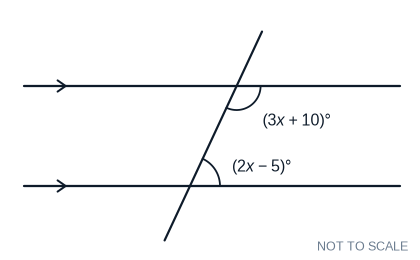
Two parallel lines cut by a transversal; the two angles between the lines on the same side of the transversal are (3x + 10) degrees and (2x - 5) degrees.

The idea

Most angle questions are solved with a small set of facts. Angles at a point add up to 360°, angles on a straight line add up to 180°, the angles of a triangle add up to 180° and the angles of a quadrilateral add up to 360°.

When a line crosses two parallel lines, it makes equal angles and angles that add up to 180°. Learn the three names: alternate, corresponding and co-interior.

For any polygon, the exterior angles add up to 360°. This is the quickest way into regular polygon questions: find one exterior angle first, then the interior angle next to it, because the two lie on a straight line.

In simpler words

Most angle problems use a few facts. Angles around a point add to 360°. Angles on a straight line add to 180°. A triangle's angles add to 180°, a quadrilateral's to 360°. When a line cuts across two parallel lines, it makes matching angles. For any polygon, the outside angles add to 360°, which is the fastest way to find the angles of a regular shape.

An everyday comparison

Walking round a polygon is like walking round a field. At each corner you turn a little, and by the time you are back where you started you have turned one full circle, 360°. That is why exterior angles always add to 360°, whatever the number of sides. The comparison stops at interior angles: the angle you turn through is the exterior angle, not the inside angle, which is 180° minus your turn.

Rules to remember

Common mistake

Students set co-interior angles equal to each other. Only alternate and corresponding angles are equal; co-interior angles add up to 180°.

In the exam

Write each angle you find on the diagram, then in your working write the value with its reason in the exact words: 'angle ABC = 70°, alternate angles are equal', or 'angles on a straight line add up to 180°'. Reasons earn marks as well as values. For a regular polygon, write exterior angle = 360° ÷ n first, then interior angle = 180° − exterior angle. For an irregular polygon, write (n − 2) × 180°, substitute and solve. Never measure the diagram; it is not drawn to scale.

Worked example

Each interior angle of a regular polygon is 160°. How many sides does the polygon have?

  1. Exterior angle = 180° − 160° = 20°.
  2. The exterior angles add up to 360°, so number of sides = 360 ÷ 20 = 18.
  3. Check: (18 − 2) × 180° ÷ 18 = 2880° ÷ 18 = 160°.

Answer: 18 sides

Ask about this

Type what you are stuck on. The helper finds the explanation, worked examples and the notes to read, free and instant.

Read the full notes

Keep going

← SymmetryCircle theorems I →Take a Maths test