
Circle theorems II

Maths · Geometry. The idea in plain words, the rules to remember, the mistake to avoid and a worked example, written and checked by Mega Lecture.

Test this topic freeAll Maths topics

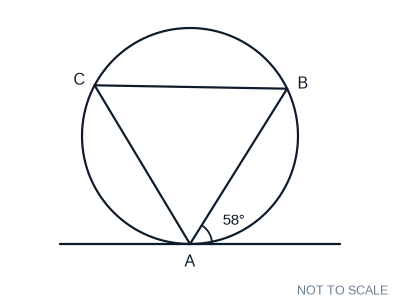
A tangent touches a circle at A; chord AB makes an angle of 58 degrees with the tangent, and C is on the circle on the other side of AB, joined to A and B.

The idea

These theorems are about chords and tangents. A line from the centre that meets a chord at 90° cuts the chord into two equal halves. This makes a right-angled triangle with the radius as its longest side, so Pythagoras' theorem gives the missing length. Chords of equal length are the same distance from the centre.

Two tangents drawn from one point outside a circle are equal in length. With the two radii they make a kite that has two right angles.

The alternate segment theorem links a tangent to a chord: the angle between them equals the angle that the chord makes at the circumference on the other side of the chord.

In simpler words

A chord is a straight line joining two points on a circle. If you draw a line from the centre straight to the chord so that it meets it at a right angle, it cuts the chord into two equal halves. A tangent is a line that just touches the circle. Two tangents drawn from the same point outside the circle are always the same length.

An everyday comparison

Think of a plate hanging on a wall from two strings tied to one nail above it. Both strings run from the nail to the edge of the plate and are the same length, just like the two tangents from one point outside a circle. The comparison stops there: real strings hang loosely, while a tangent touches the circle at exactly one point and meets the radius there at 90°.

Rules to remember

Common mistake

Students use the whole chord in Pythagoras' theorem. The right-angled triangle uses half the chord, so halve the chord first, or double your answer if you are finding the chord.

In the exam

Name the theorem before any calculation, for example "the perpendicular from the centre bisects the chord" or "tangents from an external point are equal". Mark the right angle on the diagram, halve the chord, then write Pythagoras in full: r2 = d2 + (half chord)2. Substitute the numbers, show the square root, and give the answer with its unit. For the alternate segment theorem, state it by name and write which angle equals which.

Worked example

Tangents from P touch a circle at A and B. Angle APB = 50°. C is a point on the major arc AB. Find angle ACB.

  1. PA = PB, so triangle PAB is isosceles: angle PAB = (180° − 50°) ÷ 2 = 65°.
  2. Angle PAB is the angle between tangent PA and chord AB.
  3. By the alternate segment theorem, angle ACB = angle PAB = 65°.

Answer: 65°

Ask about this

Type what you are stuck on. The helper finds the explanation, worked examples and the notes to read, free and instant.

Read the full notes

Keep going

← Circle theorems IUnits of measure →Take a Maths test