
Linear equations in two variables

Digital SAT · Math · Algebra. The idea in plain words, the rules to remember, the mistake to avoid and a worked example, written and checked by Mega Lecture.

Test this topic freeAll Digital SAT topics

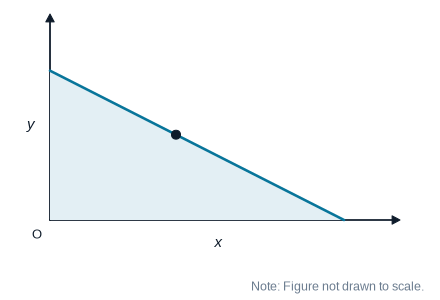
A line through the point (6, 4) with slope −1/2 in the first quadrant, and the triangle it forms with the two coordinate axes shaded.

The idea

A linear equation in two variables, such as 3x + 2y = 12, has many solutions. Each solution is a pair (x, y), and together the pairs form a straight line in the xy-plane.

Two forms are used most. Slope-intercept form, y = mx + b, shows the slope and the y-intercept at once. Standard form, Ax + By = C, is common in contexts where two kinds of item share one total, for example price × number + price × number = total cost.

To find an intercept, set the other variable to 0. To compare lines, compare slopes: parallel lines have equal slopes, and the slopes of perpendicular lines multiply to −1.

In simpler words

An equation like 3x + 2y = 12 has many solutions. Each solution is a pair of numbers, and all the pairs make a straight line. In y = mx + b you can see the slope and the starting point at once. Ax + By = C is useful when two items share one total. Parallel lines have the same slope.

An everyday comparison

Think of spending 12 dollars on pens at 3 dollars and notebooks at 2 dollars. Many mixes work: 4 pens and 0 notebooks, 2 pens and 3 notebooks, and so on. Plotting all the mixes gives a straight line. The comparison stops working because in maths x and y can be fractions or negative, while you cannot buy half a pen.

Rules to remember

Common mistake

Reading the slope straight from standard form. In 3x − 2y = 5 the slope is not 3; rearrange to y = (3/2)x − 5/2 first, which gives slope 3/2.

In the exam

Decide which form helps. To read slope and intercept, rearrange to slope-intercept form y = mx + b. For context totals, set up price × number + price × number = total. For an x-intercept, set y = 0; for a y-intercept, set x = 0. For parallel lines, show equal slopes. For perpendicular lines, show slopes multiply to −1, so the second slope is the negative reciprocal. Check one point in the original equation.

Worked example

Line k passes through (2, 5) and is perpendicular to the line 2x + 3y = 12. What is an equation of line k?

  1. Rearrange the given line: 3y = −2x + 12, so y = −(2/3)x + 4. Its slope is −2/3.
  2. Perpendicular slope: −1 ÷ (−2/3) = 3/2.
  3. Use the point (2, 5): y − 5 = (3/2)(x − 2), so y = (3/2)x − 3 + 5.
  4. Check with x = 2: (3/2)(2) + 2 = 5.

Answer: y = (3/2)x + 2

Ask about this

Type what you are stuck on. The helper finds the explanation, worked examples and the notes to read, free and instant.

Read the full notes

Keep going

← Linear functionsSystems of two linear equations →Take a Digital SAT test