
Variation, evolution and genetic technologies

Biology · Inheritance, variation and evolution. The idea in plain words, the rules to remember, the mistake to avoid and a worked example, written and checked by Mega Lecture.

Test this topic freeAll Biology topics

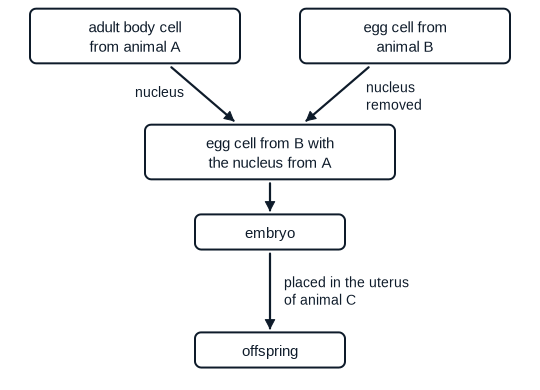
Flowchart of adult cell cloning: the nucleus from an adult body cell of animal A is put into an egg cell from animal B whose nucleus has been removed; the embryo is placed in the uterus of animal C and develops into the offspring.

The idea

Variation between individuals comes from their genes, their environment, or both. New alleles appear by mutation. In natural selection, individuals with the characteristics best suited to the environment are more likely to survive and breed, so they pass on their alleles. Over many generations the useful characteristic becomes more common.

In selective breeding, humans choose the parents. In genetic engineering, a gene from one organism is cut out and put into the genome of another to give a desired characteristic.

Clones are genetically identical individuals. They can be made from plants by cuttings or tissue culture, and from animals by embryo transplants or adult cell cloning.

In simpler words

Living things differ because of their genes, their surroundings, or both. New versions of genes come from mutation. In nature, the ones best suited to their surroundings survive and have young. Their useful features slowly become common. Humans can also choose which animals or plants breed. Scientists can even move a gene from one living thing into another.

An everyday comparison

Natural selection is like a school team trial. All the players already have different skills; the coach does not create new ones. The players best suited to the game get picked and play on. The comparison stops working because nature has no coach choosing on purpose; individuals simply survive and breed more often, and the change happens over many generations.

Rules to remember

Common mistake

Do not write that organisms change because they need to. Individuals do not adapt during their lives; the variation is already there by mutation and the environment selects it.

In the exam

Write natural selection as a sequence: variation exists from mutation, there is competition, the best suited individuals survive and breed, they pass on their alleles, and over many generations the characteristic becomes more common. For selective breeding, list the steps and give inbreeding as a risk. For genetic engineering, name the enzymes, the vector and when the gene is inserted. Give one benefit and one concern of GM crops.

Worked example

Scientists want a maize plant that makes a bacterial protein which kills the insects that eat it. Put the main steps of the genetic engineering in order.

  1. Enzymes are used to cut the gene for the protein out of the bacterial DNA.
  2. The gene is inserted into a vector, such as a plasmid or a virus.
  3. The vector carries the gene into maize cells at a very early stage of development.
  4. The plant grows with the gene in its cells and makes the protein.

Answer: Cut out the gene → put it in a vector → transfer it to early maize cells → the plant develops with the new characteristic.

Ask about this

Type what you are stuck on. The helper finds the explanation, worked examples and the notes to read, free and instant.

Read the full notes

Keep going

← Genetic inheritance, inherited disorders and sex determinationThe development of understanding of genetics and evolution →Take a Biology test